Zeche Zollverein revisited

Zeche Zollverein is part of the greater regional plan Emscher Park for an obsolete industrial region in the German Ruhrgebiet. The plan is supposed to attract leisure functions, culture, innovative companies and design firms to the green postindustrial setting. The Zollverein project, with master plan by OMA, is still running with lack of funding. The design academy with a brand new building by SANAA went bankrupt for lack of students. On the one hand parts of the complex, such as the Kohlenwäsche and the public space in front of it, are being beautifully renovated for cultural events and museum use. On the other hand, most tourists seem to prefer the rundown parts of the Kokerei, dusty, rusty and derelict.

Map of the premises: the Coking Plant, Mining Shaft XII and Shaft 1/2/8

New walkways through the main railway yard of the coal mine

The Coking Plant (Kokerei)

The Coking Plant (Kokerei)

The Coking Plant (Kokerei)

Mining carts in the old workshop


Short video impression of the complex by Mark van der Schaaf (2006)


Read more:
www.projetosurbanos.com.br/2007/05/13/zollverein-essen-germany/

Welfare State / Smashing the Ghetto

When I entered the exhibition space in Rotterdam and saw the videos of a slum being demolished by digging machines, I was almost certain that it was about some Latin American country. Not Brazil though, since the graffiti on the structures was in Spanish.

I couldn´t be more wrong, the slum was a big gypsy settlement on the outskirts of Madrid. The video is about the good intentions behind this demolition, like social equality and equal rights to housing, healthcare etc.; about how today´s utopia of equality and social integration is destroying cultural diversity (in this case the gypsy culture) and how the slum demolition becomes a spectacle of consumerist society.

The video is a project by Democracia, a Spanish artist collective founded by Pablo España and Iván López. As a travelling exhibition it was part of the Rotterdam Museumnight, 7 March 2009.

“The union between welfare and consumption is the principal characteristic of present day developed societies, with basic needs fulfilled, consumption provides new symbolic meanings that go way beyond the actual object being consumed. Freedom, social progress, solidarity and democracy are accessible through consumption and the targeting of the capitalist worldview is generated through the mechanisms of the performance […].

In this context we propose a meeting between the integrated and the marginalized society at the right time when the welfare state acts in search of justice and equality: One of the largest slum settlements in Europe still survives in Madrid, which is called El Salobral and is found in the Southern periphery of the city. Last March the Community of Madrid and the City Council agreed to its demolition and the consequent rehousing of its inhabitants, with the majority being of the gypsy ethnic group. In this settlement those persons who are clearly marginalized by socio-cultural factors are found together with those who are voluntarily there such as drug dealers in search of an area away from police vigilance. On the other hand, the demolition of the slums and the consequent relocation of its occupants attract new inhabitants who come to this area looking to be rewarded with a new home by the social services. The extinction of El Salobral not only implies the destruction of sub-standard housing but also making the land uninhabitable so that it can no longer be built on.

The project developed by Democracia conceives the staging of the demolition of this marginal community as a performance for all members of civil society. Over and above considerations such as the disappearance of specific cultural forms (that of the gypsy culture), the civil society celebrates the disappearance of the ghetto via a media performance. The “integrated” civil society are the hooligans who applaud the action of the diggers demolishing the ghetto. The path of the marginalized society is its integration in the spectacular consumption society, which will assure them of their basic rights.

www.democracia.com.es/proyectos/welfare-state/

Suez Canal

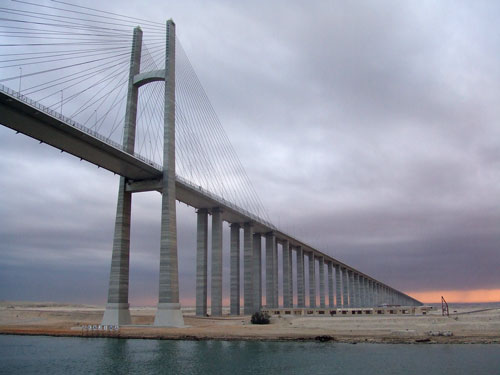
Various attempts were made to excavate a canal linking the Red Sea to the Mediterranean, from around 1850 BC by pharaoh Senuserett III, until it was finally completed by the Persian conqueror Dario I in 500 BC. In the following centuries it was destroyed, abandoned and rebuilt several times. The modern Suez Canal, from Port Said to Suez, was built by Ferdinand de Lesseps between 1859 and 1869, as ordered by Napoleon. In the end of the 19th century the British took control of the canal until it was restored to Egypt in the 1950´s. Also in the 20th century the canal was the scene of many conflicts, mainly between Arabs and Israelis. In one of these conflicts the canal was blocked by the Egyptians, trapping 14 cargo ships in the strait for over 8 years.

The intense traffic through the Suez Canal, bypassing the African continent, brings commerce and maritime activity into the heart of the Sinai desert. Irrigation works stimulated the development of cities and agrarian settlements along the canal. Due to the high salinity of the Red Sea water, which pours slowly through the strait into the Mediterranean, and the construction of the Aswan dam in the Nile, the eastern Mediterranean has been suffering from invasion by Red Sea maritime species.

There are plans to deepen the canal to accommodate supertankers until 22 meters draft, improving bulk transport that is now being offloaded to smaller vessels and reloaded at the other end of the canal. Environmentalists are against these plans as they worsen the invasion by foreign species in the Mediterranean.

Read more:
http://en.wikipedia.org/wiki/Suez_Canal

Suez salt production

Exibir mapa ampliado

GTA SP 2013


Brazilian cartoonist Luís Shiavon spent 4 years adapting the computer game Grand Theft Auto (GTA) to São Paulo. In this parodic version of the game, famous for urban violence, he included streets of São Paulo in 3 dimensions with grafitti by contemporary grafitti artists, people such as George W. Bush, agents and vehicles of the Polícia Militar, volkswagen beetles, and a sound track by Brazilian Dj´s. No touristic cliches of the city are used in the model, such as museums and famous avenues, which makes it more difficult to recognize São Paulo, but all the better to experience the dark and funny side of the metropolis.

The game can be purchased at the art gallery Choque Cultural, Pinheiros, São Paulo.

Read more: Folha de São Paulo (images with text in portuguese)

Also see: Turkish version of GTA, in Instanbul

Gaza density


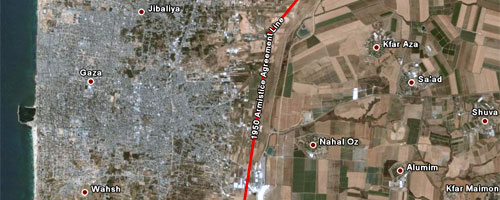
Urban density in Gaza (left) and Israel (right)

The Gaza strip, a narrow corridor of 6-12 km width and an area of 360 square km, is one of the densest territories on earth. If it were recognized as a sovereign country it would by fourth in population density worldwide, after Monaco, Singapore and Gibraltar. The list follows with already much lower densities such as the Vatican and Bahrein.

Population per square kilometer: (countries)

Monaco 16.754
Singapore 6.336
Gibraltar 4.654
Gaza Strip 4.118
The Vatican 1.866
Bahrein 1.454

Source: Wikipedia

In this list, all small territories were established as strategic sovereign countries within an existing country as a result of superior economic or political power, except Gaza. While in these countries the population density increased because of growing wealth and influence within fixed geographic boundaries, in Gaza the high population density was reached by compression of the Arab population in the areas known as Palestinian Territories.

During the 2008/2009 offensive of Israel against the Gaza strip, controlled by Hamas, what has happened demographically to this narrow strip of land with 1.4 million inhabitants, whose borders have been closed and which has been sealed off from the Mediterranean Sea? Where did all those people go after their houses and enterprises were bombed?
If built structures have disappeared, if no new building materials are entering the territory and if the current fertility rate is maintained in Gaza, the parts of the urban area that have not been destroyed must now be even more dense than they used to be.

Population per square kilometer: (cities)

Amsterdam 3.400 (2000)
Haifa (Israel) 3.500 (2000)
Gaza City 16.450 (2005)
Tel Aviv 5.050 (2000)
São Paulo 9.000 (2005)

Source: Demographia – World Urban Areas


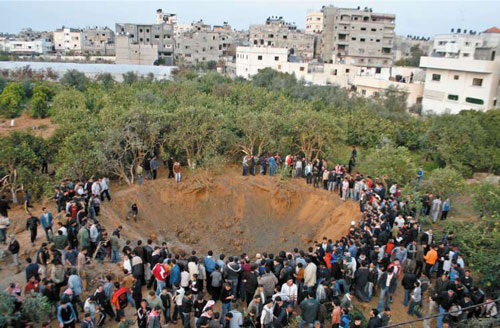
Palestinians gather around a crater left by an Israeli missile in farmland at Jabaliya refugee camp (photograph by UPPA/The Independent)

Note by the editor: The question, whether airstrikes and bombings of this kind, in high-density civilian areas, are a responsible and civilized practice, falls outside the scope of this website.