Coney Island revitalized?

The former Island (now peninsula) – located in Brooklyn New York and named “Coneyne Eylandt” (Rabbit Island) by the Dutch – has been an icon of upcoming mass spectacle and entertainment and also of fast urban decay and deterioration. Today, the area is undergoing processes of new investment and urban revitalization.

History
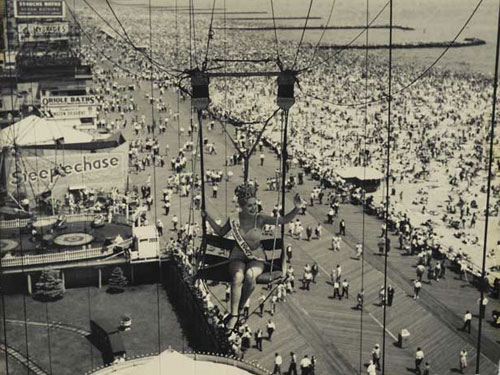
The island was developed as a beach resort from the 1860´s when it was connected by rail to Manhattan. Against the will of those who wanted to preserve the area as a nature reserve, the beach front was filled with amusement parks, restaurants, bars etc. By the beginning of the 20th century Coney Island was the largest entertainment zone in the world. At the time the wooden Boardwalk was the most expensive street in the Monopoly game. Attractions like the Cyclone and Thunderbolt rollercoasters, the Parachute Jump, Steeple Chase, Luna Park, Astroland and the hotdog gained world fame and attracted millions to Coney Island. Spotlights were installed so that the beach might be occupied 24 hours a day.
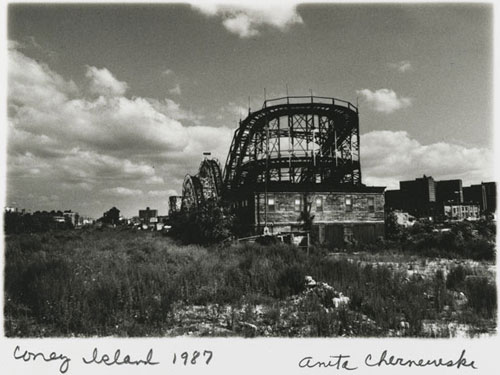
After World War II the entertainment cluster entered in decline, due to the rise of less crowdy leisure alternatives and cheaper automobiles that put more distant beaches in range. A period of abandonment and closing of amusement parks followed, in which several wooden structures were lost in fires. Several closed parks were purchased by Astroland, which eventually sold all land to the Thor corporation in 2006.
In 2003 the City of New York launched a revitalization project for the area as site for the 2012 Olympics, but did not succeed.
New development
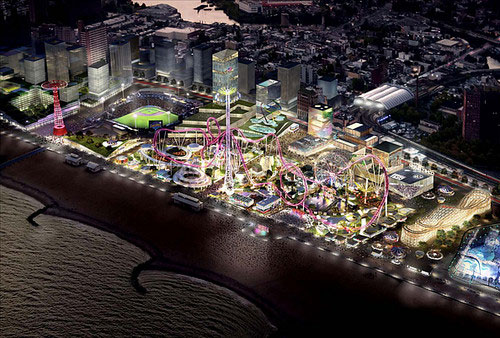
Thor Equities now pretends to turn the area into a contemporary amusement zone with hotels and a new aquarium, investing about $2 billion. The controversial plan has been widely opposed to and still waits for approval in a modified form. During the legal preparations for the development of the site, the company is leasing it back temporarily to Astroland and other amusement businesses.
Read more:

Wikipedia
http://en.wikipedia.org/wiki/Coney_Island

Coney Island Under Siege – article by David Hershkovits
www.papermag.com/…

Coney Island
www.coneyisland.com

Delirious New York: A retroactive Manifesto for Manhattan
book by Rem Koolhaas, London 1978


Exibir mapa ampliado

Raumlabor – Küchenmonument

Berlin-based studio Raumlabor designed an air blob that can be blown into a temporary space for eating and dancing at about every available spot in the city. The object has travelled between several points in Duisburg and Mülheim (Germany). In October the studio will realize an intervention on a vacant spot in New York.
The project was developed together with Plastique Fantastique, which is specialized in pneumatic spaces.

Box academy under São Paulo flyover

Photo Roberto Cattani

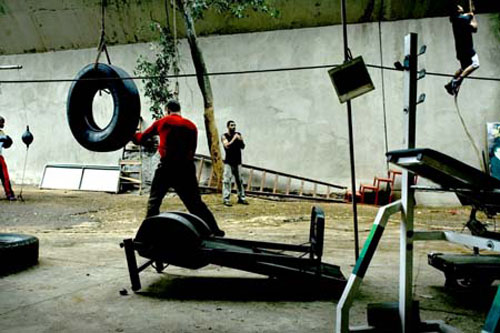
Under the Viaduto do Café in central São Paulo a box academy operates since 2006. The project, initiative of ex boxer Nilson Garrido, started under a gallery in the Anhangabaú valley in 2005. When the municipality reclaimed the space a new spot was found under the flyover. The complex started off with used materials such as car parts to equip the academy, at a later stage it received donations of professional fitness gear.
Fábio Garrido, Nilson´s father, says in an interview with Estado de São Paulo that when Rocky Balboa started in the 70ties, he must have copied Garrido´s idea, because he was already setting up his informal academies in Brazil.

Photo João Kehl - World Press Photo 2007
Besides box trainings and competitions, the project serves free meals for the homeless and maintains a public library of donated books. At first the neighborhood was divided about the box ring at the crossing that was used as illegal parking lot at the time, but later the initiative became fully accepted. In 2007 a photograph of the academy won World Press Photo in the category Sport Features and Stories.

Due to the succes of the project the district of Mooca offered another flyover, Alcântara Machado, to implement public sports facilities.
In 2008 architect Igor Guatelli developed an project to improve the academy under Viaduto do Café, which is currently under construction, and at the same time uses the experience for his Phd thesis.
Image Igor Guatelli

See also:

Video by Gilberto Dimenstein (portuguese)
www1.folha.uol.com.br/folha/videocasts/…

Academia de boxe debaixo do viaduto (portuguese)
Article by Aryane Cararo for Estado de S. Paulo
www.estado.com.br/suplementos/…

Jogo de cintura (portuguese)
Article by Eugênio dos Santos for Portal SESC SP
www.sescsp.org.br/sesc/revistas_sesc/…

Interview with Igor Guatelli (portuguese)
www.vitruvius.com.br/entrevista/guatelli/…


Exibir mapa ampliado

Urban farming

Urban farming is more and more part of daily life of city dwellers in the US and (especially Eastern) Europe. Growing vegetables and lifestock in high density urban areas might seem as something strange, but according to various articles the practice of urban farming and the presence of “rural” animals in cities has always existed. In the past it has been necessary as survival strategy, for example during the urban famine at the end of the second World War.

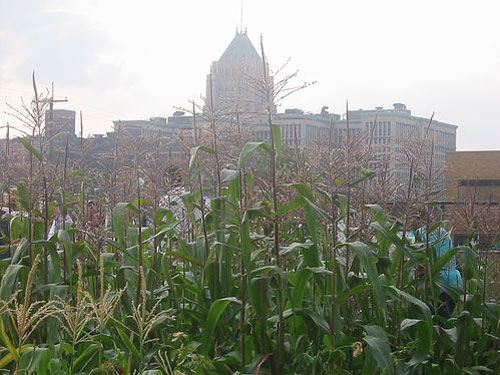
Corn field in downtown DetroitPhoto Baliad

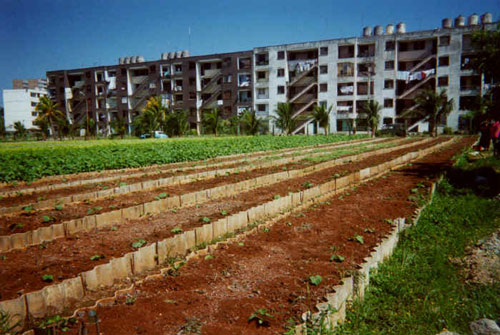
Today urban farming rises as an alternative for expensive, energy-consuming, processed and imported nutrients. Home growing increases control on the quality of the food and eliminates most of the transport costs. In Africa and other developing regions it´s creating independence for the urban poor. Besides these practical reasons, urban farming has been undertaken as revitalization strategies for abandoned urban sites, such as in Detroit. The resulting urban farms serve also as educational and recreational centers for the neighborhood. Exactly for being high density urban areas, these neighborhoods rarely have any legal restrictions on the growing of certain plants and keeping of unusual animals, which makes urban farms easy to be implemented.

Urban farming in Havana, Cuba
Photo Cityspinning

Articles:

Urban Farming: Back to the land in your tiny backyard
Carol Lloyd, San Fransisco Chronicle, 27 June 2008
www.sfgate.com/…

Designs of the time 2007 – Urban Farming
www.dott07.com/go/urbanfarming

Urban farming takes root in Detroit
Matthew Wells, BBC News, Detroit, 10 July 2008
http://news.bbc.co.uk/…

Vacant space vs. New development

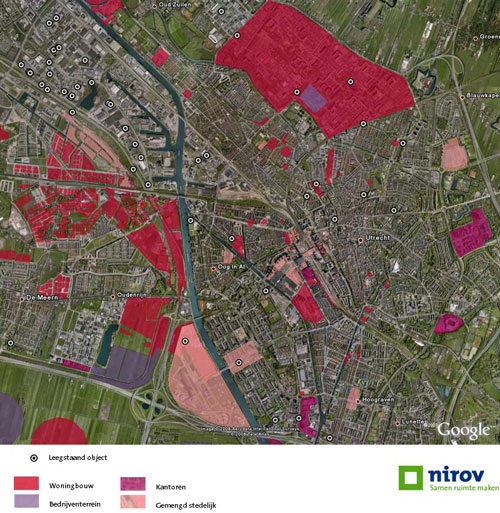
The Dutch “New Map” joins planning information of all municipalities in the Netherlands and gives a rather good idea of what the country will look like 10 years from now. Another project, called “The Old Map of the Netherlands”, gathered information on vacant lots and buildings.

When these two maps are put together, one finds that most vacant spaces are actually located outside the new development of housing, offices, commerce and leisure. This means that the potential of vacant space remains unused in Dutch urban planning. It also means there is still a bright future for squatting movements, just pick up the list and go…

Nirov Quickscan for the city Utrecht (searching for overlaps in the two maps, vacancy and urban development). Manon van Heusden en Jan Kadijk 23-06-08
Image by NIROV

Nirov Quickscan
www.nirov.nl/static/nieuws/Quickscan_OudeKaart_NieuweKaart.pdf

Nieuwe Kaart van Nederland (New Map of the Netherlands – new planning developments)
www.nieuwekaart.nl

Oude Kaart van Nederland (Old Map of the Netherlands – vacancy and possibilities for reuse)
www.oudekaartnederland.nl/okn.html